

The holiday season is a crucial time for email marketing. Between Black Friday, Cyber Monday, and Christmas, your customers’ inboxes become a real battleground, with every brand trying to grab their attention. When done well, an email marketing strategy during this period can boost your sales, strengthen customer loyalty and enhance your brand awareness.
So, how can you make your newsletters stand out and maximise their impact? Here are the 6 essential steps to make your year-end campaigns a success.
1. Define your campaign objectives
Even before designing your newsletters, clarify your objectives:
- Do you want to drive more traffic to your website?
- Increase your open or click-through rates?
- Promote a special offer or clear out certain products?
Setting clear objectives will allow you to craft tailored messages, measure your performance, and adjust your actions throughout the campaign.
2. Plan your campaigns in advance
The success of an email campaign depends on preparation. By starting your actions in November, you can:
- Build anticipation with teasers for your Black Friday/Christmas offers.
- Test your messages, segments, and subject lines to optimise performance
- Set up a clear sending schedule: announce the offer, highlight key products, send a reminder 7 days before, last-chance emails before Christmas, and a post-holiday relational message (thank-yous, return policy, etc.).
Email deliverability becomes more challenging at the end of the year due to the sharp increase in sending volumes. Email providers may limit sending rates to protect their infrastructure. Probance has strengthened its infrastructure to ensure higher sending capacity and reduce the impact on your campaigns. During these special days, we recommend avoiding mass sends to your entire contact list at times when recipients are already receiving a lot of emails, such as on the morning of Black Friday; instead, focus on your most engaged segments. Schedule your sends in advance and avoid targeting addresses that have been inactive for too long.
Our deliverability team will monitor the quality of your sending performance throughout this period.
Create a sending schedule
Decide in advance how many newsletters you will send for your Christmas campaign.
For example:
- November: a first email in which you present your offer, highlight key products, etc.
- Late November to mid-December: a second email highlighting certain products or categories based on your stock levels, and adjust your strategy according to the initial sales.
- J-7 : don’t hesitate to create a sense of urgency while also providing tips and suggesting gift ideas. Inform your customers about your delivery guarantees and the deadline by which their orders can be delivered before Christmas.
- For retailers with a physical store, make sure to inform your customers of your opening days and hours during the holiday season.
- J+2 : wish your customers a Merry Christmas. You can also take this opportunity to communicate your returns and exchanges policy.
Once the list is set, all that’s left is to design your newsletters and schedule their send dates according to the planned calendar. Follow-up emails can help recover sales from subscribers who didn’t respond immediately.
Tip: For those who clicked but didn’t complete their purchase, follow up with a special offer or a message that creates a sense of urgency.
3. Target recipients, content, and offers
Targeting is a key step to increase the effectiveness of your email campaigns during the holidays. Your contacts receive a large number of messages at this time, so it’s crucial to reach the right person at the right moment.
Segment your contact list
Probance’s recommendation: focus on your active contacts.
Although it may be tempting to include your inactive contacts during a strategic sales period (Christmas, Black Friday, sales, Mother’s/Father’s Day…), this carries two major risks:
- Damage your brand’s reputation (increase in complaints, unsubscribes, poor deliverability)
- Achieve low-return results, as inactive contacts are less likely to open and click.
However, if you decide to reach out to your inactive contacts nonetheless, here are some best practices to minimise the risks:
- Moderate the frequency of your messages: there’s no need to send them all your holiday newsletters. Instead, select a few key campaigns (e.g., special offer launches, last-chance emails before Christmas).
- Closely analyse performance: monitor open rates, click rates, and unsubscribes. As soon as the risk becomes too high (e.g., unusually high complaint rates), reduce the pressure and volume.
👉 Concrete examples of segmentation for your year-end campaigns:
- Active contacts: have opened, clicked, or visited in the last 12 months, or have ordered/added to cart in the last 3 years.
- Christmas shoppers: customers who purchased in November/December of the previous year. Sending them an exclusive promo code is an excellent way to boost sales and strengthen loyalty.
- Recent buyers: by default, Probance targets ‘Recent buyers – less than 6 months’
- VIP buyers: by default in Probance, this segment includes contacts who have made at least 2 purchases and 1 click in the last 12 months.
To learn more:
Check out our tutorial on Building a campaign target.
Tip: Set up specific scenarios for your loyal customers, new clients, or those who have recently abandoned their cart.
Personalise your emails
Why personalisation is essential in your email campaigns
Today, personalising an email is no longer just about inserting the recipient’s first name in the subject line or header. Truly effective personalisation relies on smart use of your contacts’ behavioural and profile data.
Personalisation that boosts engagement
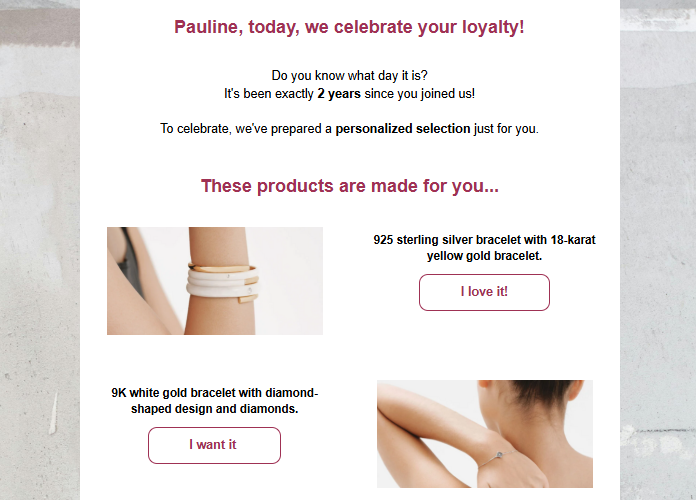
Take the example of a newsletter sent to Pauline, a loyal customer for 2 years. With precise personalisation, you can:
- Create an emotional connection: by addressing her directly and highlighting her loyalty, you strengthen her relationship with your brand.
- Reward loyalty: mentioning the length of the customer relationship shows that you are tracking their journey.
- Increase engagement: a personalised message captures more attention and encourages recipients to explore the content offered.
- Offer a tailored experience: by suggesting a selection of products that match their preferences or habits, you make your email much more relevant.
Personalisation tools in your templates
In your Fastbuilder campaign editor, you have several personalisation tags: title, first name, registration date, birthday, etc. These tags are automatically replaced with the recipient’s information at the time of sending.
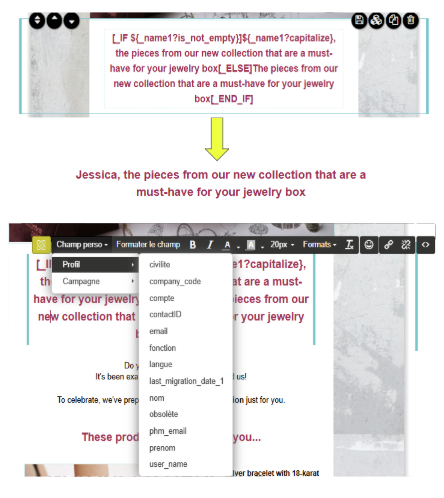
The formatters allow you to adjust how this data is displayed:
- Capitalize the last name
- Long date format (’12 February 2023′)
- Capitalize the first letter of the first name
- …
To learn more:
Read our tutorial on How to personalise your emails using your recipients’ information
Conditional display: tailor your content to each profile
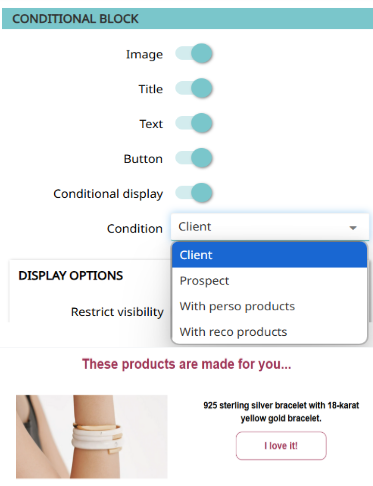
With conditional blocks, you can dynamically tailor the content of your newsletter:
- Display a recommendations block only if the recipient has any.
- Reserve a promotional offer for new prospects.
- Offer a specific selection to loyal customers or regular buyers.
This level of personalisation allows you to target intelligently:
- Buyers
- Prospects
- Contacts with recommended or personalised products
To learn more: watch our video on How to set up a conditional block in Fast Builder
RECO vs PERSO: two types of dynamic offers
- PERSO offers: products the contact has already interacted with (purchase, added to cart, visit).
- RECO offers: recommendations based on the contact’s behaviour, selected by Probance algorithms from the most popular or fast-growing products, not purchased in the last 180 days.
These selections are based on:
- The most visited category
- The preferred brand
- Purchase history
Configure your product blocks effectively
In the Content tab of the recommendation block:
- Set the maximum number of products displayed (up to 6).
- Choose the desired display (list or columns).
- Select the product information to display (price, label, image…).
⚠️ Do not include multiple recommendation blocks in the same email, as this may result in repeating the same products.
Filter the recommended products
Add selection filters to target the displayed products more precisely:
- Products in stock
- Price below a certain amount
- Catégories ou marques spécifiques
To learn more about how filters and product recommendations work, see our article: Including personalized product recommendations in your emails.
Watch our tutorial video on How to add product recommendations to your newsletters.
4. Adapt the content and design
During the holiday season, your customers receive a multitude of emails. To stand out, your messages need to be relevant, engaging, and tailored to their habits.
Mobile-first structure
At the end of the year, over 80% of opens occur on smartphones. Your content should therefore be designed with mobile in mind:
- A clean and responsive design,
- Clear and spacious blocks,
- A call-to-action button visible from the first scroll.
Highlight a special offer
At Christmas, your contacts will be heavily solicited, so set up a special promotion using a coupon or discount code.
For example, you could offer free delivery, gift wrapping, or include a small gift with each order…
These tangible benefits encourage purchases and create a sense of exclusivity.
Showcase your story and values
The holiday season is the best time to boost your sales and strengthen your relationships with your customers. It is also the perfect opportunity to share your company’s story with them.
You need to show your customers that you value them. Don’t just send emails to promote your products; also share engaging and attractive content. Use storytelling techniques, highlight your values, and sell your story.
By creating this kind of content, your customers can become ambassadors for your brand. Showcase what makes you unique to stand out from your competitors.
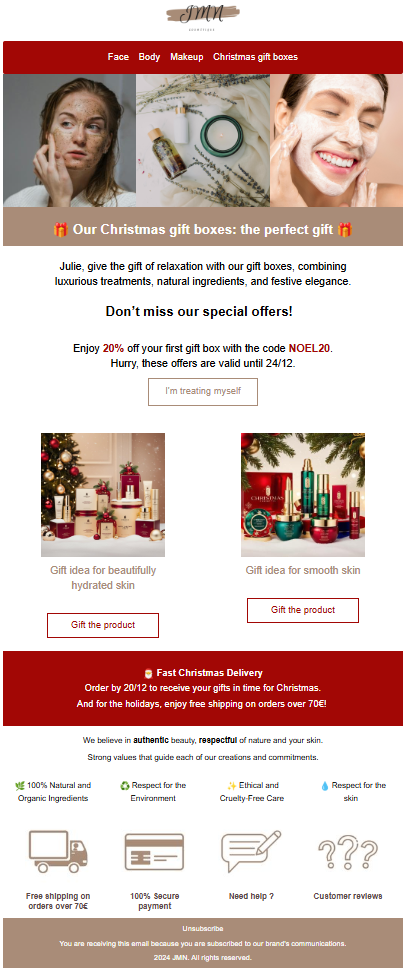
- 1 – Personalised content with the recipient’s first name
- 2 – Highlight the promotional offer
- 3 – Emphasise delivery guarantees and customer service contact
- 4 – A CTA linking to the website or a specific page
- 5 – Showcase content – gift idea suggestions
- 6 – Highlight benefits (free delivery, secure payment, 24/7 customer service, etc.)
- 7 – Don’t forget the unsubscribe link!
We suggest using Pablo, P-ONE’s generative AI assistant, which simplifies the creation of engaging content for your emails.
To learn more, watch the tutorial video: How to generate text content in your templates with Probance AI.
Adapt your design
Christmas is also an opportunity to update your email template, adapting it with colours and images related to the festive season. Be careful not to overload it with images, as this could reduce its effectiveness. A coherent email theme that matches the content will improve the overall performance of the campaign.
Use attractive banners, GIFs, or videos to showcase your key products in a fun and festive way.
Tip: Add personalised promo codes that are clearly visible within the email to make the offer even more compelling.
Increase the number of calls-to-action
Each email should have a clear objective. Use impactful CTAs:
- Short and engaging (‘I’m taking advantage of the offer’, ‘Give a gift now’)
- Visible thanks to good contrast,
- Repeated several times throughout the email.
Create a sense of urgency
The holiday season is a great opportunity to boost conversions by leveraging time-sensitive messaging:
- Include a countdown timer for limited-time offers,
- Highlight low stock availability,
- Tell a story around the festive spirit to evoke emotion.
5. Ensure good deliverability
The volume of emails soars in December: without best practices, your messages risk ending up in spam. A few guidelines:
- Authenticate your sends (SPF, DKIM, DMARC).
- Regularly clean your databases (hard bounces, long-term inactive contacts).
- Avoid sending spikes: gradually increase your sending volume from November.
- Monitor your performance (open rates, clicks, unsubscribes) and adjust your sends accordingly.
Good deliverability is essential to ensure your emails reach your customers’ inboxes. The holiday season is particularly sensitive: over-contacting your recipients can quickly harm your sender reputation.
👉 Don’t send all your communications to your entire contact list! As a reminder, here are the best practices to follow:
- 1 newsletter per week for active contacts.
- Maximum 1 newsletter per month for your entire contact list.
- Avoid systematically sending follow-ups to non-openers, as this can harm your rates and increase the risk of complaints.
As mentioned previously, email deliverability becomes more complex at the end of the year due to the massive increase in sending volumes. Email providers may then limit throughput in order to protect their infrastructures. At Probance, we have strengthened our own infrastructure to ensure a higher sending rate and thus reduce the impact on your campaigns.
During these key days, we recommend:
- Avoid mass mailings to your entire database, especially at peak times (for example, on the morning of Black Friday),
- Focus on your most engaged segments,
- Schedule your mailings in advance,
- And avoid targeting addresses that have been inactive for too long.
Finally, our deliverability team will closely monitor your performance throughout this period to maximise your results.
Did you know?
At Probance, our experts support you with deliverability.
– Deliverability Audit Service (20 credits): Probance carries out a complete audit of your deliverability (at the project or production stage) and provides you with a personalised action plan to optimise your mailings.For more information, contact your account manager.
6. Test and analyse your campaigns
We often remind you: A/B testing is an essential lever for successful email campaigns. The earlier you start sending your newsletters, the more time you will have to test and optimise your variants.
Launch your tests in advance
Select a small sample of your recipients and test different versions of your email in order to identify:
- The best subject line (the one that generates the highest open rate),
- The most effective offer (the one that gets the most clicks and sales),
- The design or call-to-action that drives the most engagement.
Then, deploy the winning variant to the rest of your database to maximise your results.
Analyse your statistics
The data collected will allow you to:
- Measure the revenue generated by your campaigns,
- Distinguish high-performing newsletters from less effective ones,
- Identify the most popular products and categories through click tracking.
Adjust your segments in real time
During the holiday season, behaviours change rapidly. Monitor your segments and adjust your mailings:
- A customer who opens your emails but doesn’t purchase could receive an incentive or promo code,
- A regular buyer could benefit from a loyalty or VIP offer.
All these analyses will allow you to create newsletters that are increasingly relevant and effective.
To go further, check out our article: Performing an A/B test on an email newsletter
New at Probance: Optimised A/B Testiné
An optimised A/B test operates fully automatically: several variants of the same campaign are sent over a defined period— a few hours for a newsletter, several days or weeks for an automated campaign. At the end of this period, P-ONE automatically identifies the best-performing version and sends it to the rest of the target audience, as well as to all future recipients of the campaign.
To learn more, read our article: Running optimized A/B testing on an email campaign
Did you know?
At Probance, our experts support you in creating newsletters.
– Newsletter Creation Service (45 credits): Need extra support during key moments of your activity? You select the highlights that interest you, and we create, set up, and analyse the performance of your newsletters.For more information, contact your account manager.
📌 And if you need help designing your campaigns, contact your account manager: we’re here to support you!