
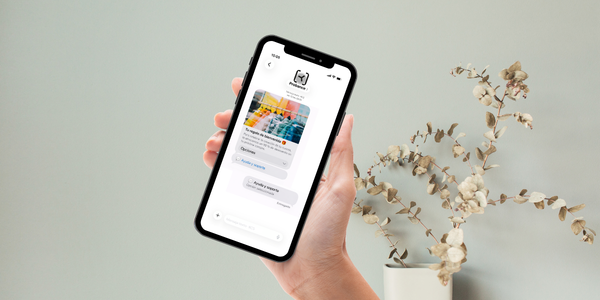
Your customer base is already there. Your automation scenarios are too. What was missing was a mobile channel capable of doing more than just text.
The challenge
For most e-commerce businesses, the situation is the same:
the customer base is there, often a substantial one, but marketing automation remains underused.
A few campaigns, a few automated scenarios… but still far from its full potential.
Meanwhile, SMS remains effective but limited, while email is increasingly struggling to capture attention.
👉 What if the issue wasn’t your strategy… but the channel itself?
What RCS changes in practice
RCS (Rich Communication Services) transforms SMS into an interactive, conversational experience directly within the phone’s native messaging app. No app to install, no new audience to build: the same messaging environment as SMS, but with a completely different format.
Five things become possible.
1. Display rich visual content
With RCS, you’re no longer limited to text.
You can include:
- product cards
- carousels
- visuals directly within the message
👉 The result: you capture attention immediately => a critical advantage when most messages are scanned in just a few seconds.
2. Enable actions directly within the message
This is where RCS becomes particularly valuable for CRM.
You can provide:
- direct access to a product page
- a link to a personalized offer
- quick replies
👉 Users no longer need to navigate through multiple steps:
they can take action directly from the message.
More importantly, they land directly at the key stage of the customer journey , product, cart, or conversion.
3. Measure engagement just like email
Unlike SMS, RCS allows you to track:
- opens
- clicks
- interactions
👉 Mobile messaging finally becomes measurable and actionable.
4. Personalize your messages
Just like with email, you can leverage your customer data:
- first name
- purchase history
- product recommendations
👉 And this is where RCS really makes sense for your teams:
you’re no longer sending mass messages, but delivering personalized CRM experiences.
5. Continuously test and optimize
RCS fits perfectly into a marketing automation strategy:
- A/B testing content
- optimizing automated scenarios
- continuous improvement
👉 Exactly as you would with email… but on mobile.
From SMS to RCS
| SMS | RCS | |
|---|---|---|
| Sender | A number or short name | Your brand, with its logo |
| Content | Plain text, shortened link | Product visuals, title, rich formatting |
| Action | Leave the message and open a browser | Buttons integrated directly into the message |
| Measurement | Sending and delivery | Opens, clicks, interactions |
The message doesn’t just make a better impression. It requires less effort from the recipient and that is precisely what translates into higher conversion.
Better performance than SMS
The results speak for themselves:
➡️ up to 2 to 5 times more clicks than SMS
➡️ up to 3 times higher conversion rates
Why?
Because three effects work together:
- visuals capture attention more effectively
- direct actions remove unnecessary steps
- the overall experience is smoother
👉 In short, RCS reduces friction between the message and conversion.
Where RCS delivers the most value
RCS is not just a “new channel.”
It is particularly powerful for high-impact CRM scenarios:
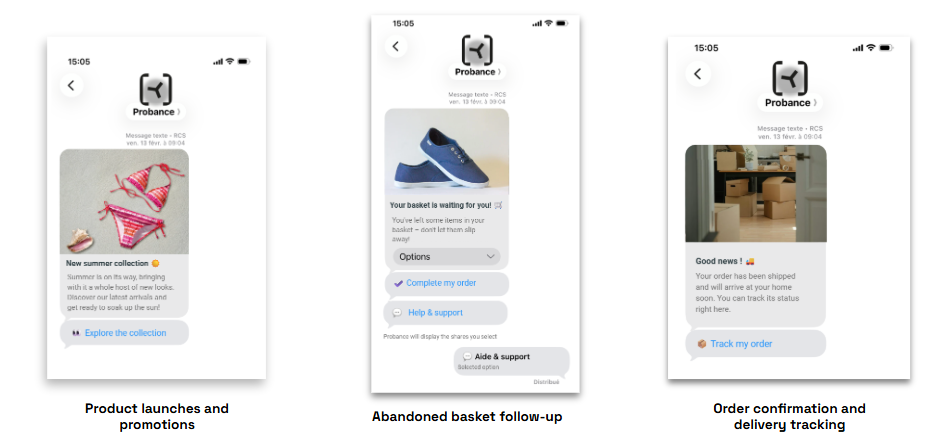
Product launches and promotions
Showcase your products directly within the message and drive qualified traffic.
Abandoned cart reminders
Display the abandoned product and redirect customers to their cart in a single click.
👉 Quick to implement, with immediate ROI.
Order confirmation and delivery tracking
Improve the customer experience with useful interactions.
👉 Greater customer satisfaction + stronger loyalty.
Is RCS right for your organization?
Four signals are generally enough to tell:
- you have a substantial customer base that you are only partially activating today
- you have a rich product catalog that is difficult to showcase effectively in a text-based SMS
- you already have CRM scenarios in place, but they are limited to email
- your acquisition costs are rising and you need to generate more revenue without adding new acquisition channels
=> If three of these four points sound familiar, RCS is worth exploring.
RCS by Probance: A channel you can activate without added complexity
RCS is directly integrated into Probance One. Your teams have access to the same capabilities as on other channels: targeting, product recommendations, and marketing pressure management.
From a single platform, you can:
- manage your RCS campaigns, whether newsletters or automated scenarios, and analyze their performance
- create rich messages with cards, carousels, and buttons
- activate an automatic SMS fallback when a recipient’s device is not RCS-compatible
This last point matters more than it may seem. You do not need to segment your database based on RCS compatibility or manage two campaigns in parallel: the message is sent once, and each recipient receives it in the best available format.
The result: you can deploy a new channel without adding complexity to your tech stack or relying on IT.
RCS doesn’t replace anything: it complements
This is probably the most important point and the one most often misunderstood. RCS is not designed to replace email, or even SMS. It takes its place within an omnichannel strategy, alongside the channels you already use.
In practice, this means three things.
The same segments, the same data. You do not need to build a separate RCS audience. Your segments, product recommendations, and targeting rules remain the same, regardless of the channel.
Marketing pressure managed globally. This is essential when adding another channel: without centralized coordination, adding RCS simply means adding more customer touchpoints. In Probance One, marketing pressure is managed across all channels, rather than channel by channel.
The right channel at the right time. An abandoned cart reminder does not necessarily call for the same channel if it is sent within the first hour versus three days later. The goal of an omnichannel strategy is not to send more messages, but to choose the right channel and automatically switch when another channel does not deliver the expected response.
It is this orchestration, more than any individual channel , that drives results.
👉 Want to develop your multichannel strategy? Read our article Diversify Your Channels
The real opportunity: Making better use of your customer base
Today, the difference between two e-commerce businesses is no longer just about acquisition.
It is about how effectively they leverage their customer base.
RCS is not simply another channel.
It is a way to get more value from what you already have:
- your data
- your product catalog
- your CRM scenarios
Why you should activate the channel before the holiday season
Black Friday, Cyber Monday, Christmas, sales periods: this is when your customer base generates the most revenue and when inboxes are at their most crowded. It is therefore also when a channel that stands out can deliver the greatest impact, provided it is fully operational when the season begins. It is also when the most profitable RCS scenarios, starting with abandoned cart reminders, are running at full capacity.
And that is precisely why you need to start early. Activating the channel requires your brand to be certified by mobile operators, a process that generally takes more than a month. On top of that, you need time for setup, rich content creation, and scenario configuration.
In other words: a project launched in November will not be ready for Black Friday. A channel activated in September will.
👉 To prepare your campaigns for Black Friday, read our guide!
Want to see what RCS could look like for your business?
It is no longer simply about sending messages.
It is about creating interactions, guiding customer journeys, and driving conversions.
The easiest way is to discuss it with your Probance Account Manager. Based on your existing scenarios, product catalog, and customer database, they will work with you to identify the two or three use cases to activate first.